
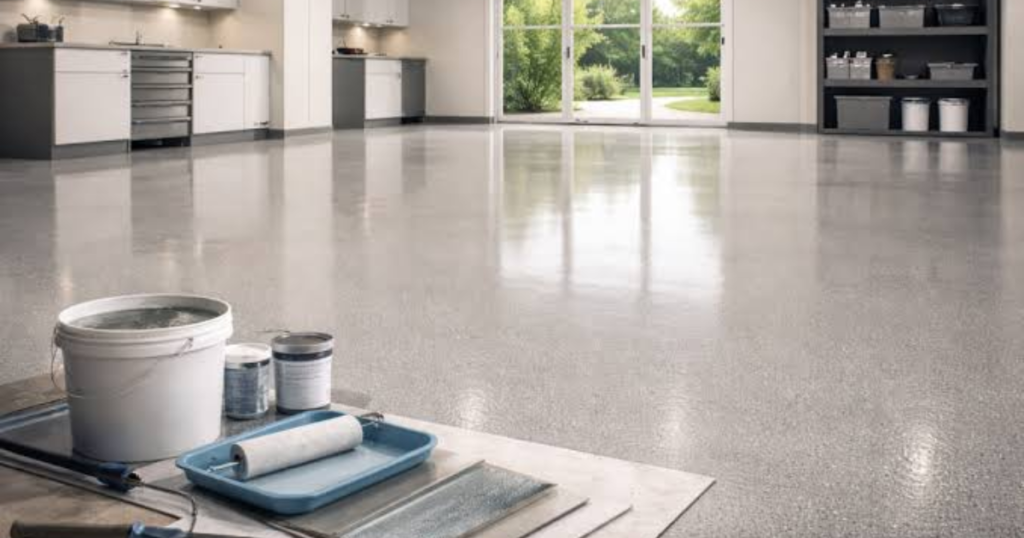
If you’ve looked into garage floor options recently, or if you’ve noticed a showroom-quality floor somewhere and wondered what it was, there’s a good chance you were looking at decorative epoxy coating. It’s been gaining popularity fast, and for good reason. It combines the kind of industrial-grade durability that protects concrete from daily wear with a finished appearance you actually get to choose. That combination is harder to find than you might think.
Most people know epoxy as a protective coating. What they don’t always realize is that decorative epoxy coating takes that same structural foundation and adds genuine visual options to it. You’re not trading durability for looks. You’re getting both. Here’s a clear breakdown of how it works, what your options are, and where it makes the most sense to use it.
How It’s Different From Standard Epoxy
Standard epoxy is applied primarily for protection. It provides chemical resistance, abrasion resistance, and easier cleaning. It does that job well, but the result is typically a flat, single-color surface that reads as purely functional.
Decorative epoxy coating adds a design layer to that same structural foundation. The chemistry is similar. The performance characteristics are comparable. What changes is the finish. Visual elements, whether metallic pigments, colored vinyl flakes, or quartz aggregate, are incorporated directly into the coating layers. The floor itself becomes part of the design rather than just a surface to protect. That’s what makes it stand out.
The Main System Types
Metallic epoxy is the most visually distinctive option. Metallic pigment is suspended in a clear carrier that moves during application, creating depth and variation that looks almost three-dimensional once cured. No two metallic floors come out exactly the same, which is either a selling point or a practical limitation depending on what you need. For residential spaces, home gyms, and garage conversions, the unique character of a metallic finish is often exactly what homeowners are after.
Flake systems, also called chip or broadcast systems, are the most common type of decorative epoxy coating for garages, commercial spaces, and high-traffic areas. Colored vinyl chips are broadcast across a wet base coat, then locked in under a clear topcoat. The density of the broadcast affects both the look and the slip resistance, so that choice has functional consequences in addition to aesthetic ones. Full-broadcast flake systems cover the base coat entirely. Partial-broadcast leaves some base coat visible. Both look sharp and hold up exceptionally well.
Quartz aggregate systems press fine colored sand into the coating surface. The result is a harder, more textured finish than metallic or flake options. These are commonly used in commercial kitchens, restrooms, and anywhere wet conditions make slip resistance a genuine requirement.
Why Preparation Is Everything
The most important phase of any decorative coating installation is the one you never see when the job is done. Surface preparation. The epoxy needs to bond to a properly profiled concrete surface. That typically means mechanical diamond grinding to open the concrete pores, followed by crack repair and a moisture check. A contractor who skips or rushes this phase is the single most common reason epoxy fails within a few years. The coating looks fine initially and then starts to delaminate.
When the prep work is done correctly, a quality decorative epoxy coating bonds tightly to the concrete and lasts for a decade or more with basic maintenance. When it isn’t, no amount of quality material makes up for the compromised foundation.
Where It Makes The Most Sense
The range of appropriate settings is genuinely wide. Residential garages, home gyms, converted spaces, and covered patios are some of the most common applications. On the commercial side, retail floors, restaurant back-of-house spaces, and automotive shops all benefit from the combination of durability and visual quality that decorative epoxy coating delivers.
The spaces where it’s not a good fit are worth knowing too. Surfaces that receive prolonged direct UV exposure need UV-stable formulations specifically. Wood subfloors are not an appropriate substrate. And high-heat environments can affect certain system types. If you’re unsure whether your space is a good candidate, a site visit is the fastest way to get a straight answer.
Is It Worth The Investment?
When you compare it to other flooring options that also provide both durability and a good appearance, decorative epoxy coating is consistently one of the most cost-effective choices available. The upfront cost is modest relative to what you get, and when the installation is done correctly, the floor performs without issue for years.
At Toros Pool Decking, we install flake, metallic, and solid-color epoxy systems for garages, patios, and commercial spaces throughout the Tempe area. If you want to see what the right system looks like for your space, reach out and we’ll walk you through the options. Ready to upgrade your floors? Contact us to learn more about decorative epoxy coating options and get a free, no-obligation estimate for your Tempe area property.